

A spiking engine temperature gauge on Tucson roads does not mean your radiator is dead. A stuck thermostat restricts coolant flow, creating identical overheating symptoms under summer heat. Thermal mapping and pressure testing confirm whether coolant is circulating before approving a major radiator replacement.
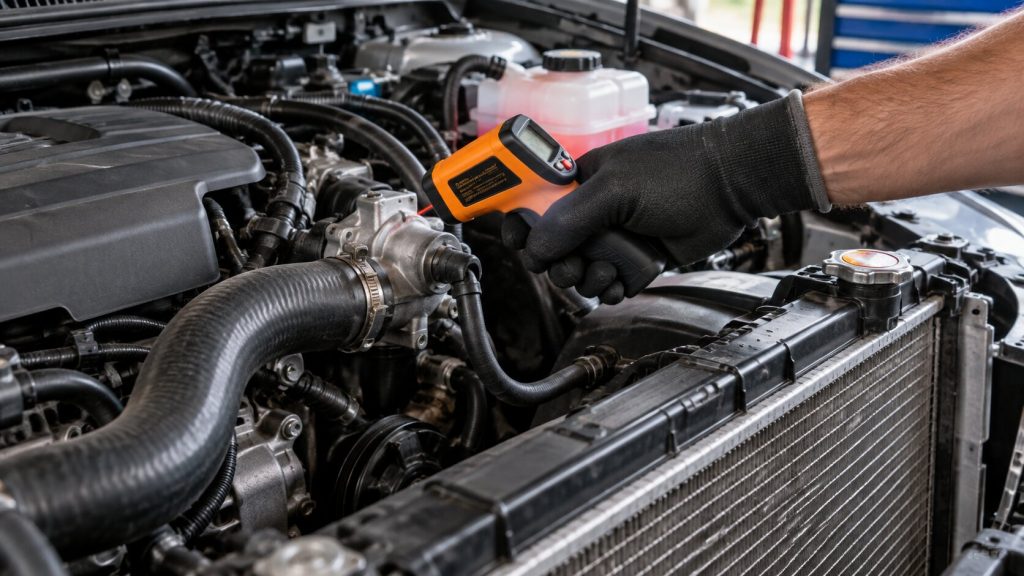
Navigating Campbell Avenue during peak summer heat exerts significant thermal stress on an engine cooling loop. When your temperature needle surges past normal levels while idling at a red light on Broadway Boulevard, jumping to the conclusion that the radiator is ruined often results in replacing a major assembly when a minor valve is the actual culprit. In my experience, determining whether overheating is driven by restricted flow or reduced heat dissipation requires systematic testing before performing major radiator replacement.
Why Engine Overheating Drives Misdiagnoses in Tucson
When a vehicle arrives at my service bay with its temperature needle pinned near the red zone, drivers frequently ask me for an immediate radiator replacement estimate. However, intense desert road heat stresses every plastic, rubber, and wax component in the system equally.
A stuck thermostat valve impedes coolant circulation just as severely as an internally blocked radiator core. If I were to install a brand-new radiator without evaluating hose temperature differentials first, the underlying issue would remain unresolved, meaning the engine would continue to overheat before you even make it to Speedway Boulevard.
How Thermostat Malfunctions Trigger False Radiator Failures
I like to explain an engine thermostat as a temperature-controlled gatekeeper. Inside its housing, a sealed wax element expands as engine coolant approaches normal operating thresholds. Once expanded, it physically drives the valve open, permitting scorching fluid to pass out of the engine block and into the radiator.
If that wax charge escapes or the internal spring mechanically binds, the valve remains closed. Coolant becomes trapped inside the engine casing and rapidly boils. Meanwhile, the downstream radiator stays relatively cool because fresh fluid cannot enter. Detecting a cold lower radiator hose while the engine boils frequently tricks vehicle owners and inexperienced techs into believing the radiator core is completely clogged.
Key Differences Between a Clogged Radiator and a Stuck Valve
When I am identifying whether a failure stems from a stuck thermostat or a restricted radiator, it comes down to how heat moves through the system:
- Heat Rise Pattern: A closed thermostat triggers a rapid, severe temperature jump within minutes of starting the engine, whereas a blocked radiator leads to a gradual heat buildup when working the vehicle hard on steep inclines or while towing.
- Upper Hose Condition: When a thermostat remains closed, I find the top hose becomes extremely hot and experiences intense pressure buildup, yet coolant remains unable to circulate through the valve.
- Lower Hose Condition: If a thermostat is jammed shut, I notice the bottom hose stays cool to the touch since hot fluid never reaches it. By contrast, a restricted radiator allows coolant into the lower hose so it feels warm, but the core fails to dissipate the heat properly.
- Temperature Drops: A seized thermostat produces a sharp, localized temperature contrast right across its housing, while a clogged radiator core displays inconsistent cold patches throughout its surface.
Step-by-Step Thermostat Testing Protocol
- Infrared Thermal Hose Mapping: Directing an infrared thermometer at the top hose, thermostat housing, and bottom hose as the engine warms up reveals clear circulation patterns. A wide temperature variation between the upper and lower hoses tells me that fluid is trapped behind the valve rather than circulating through the cooling core.
- Cooling System Pressure Verification: Attaching a pressure gauge directly to the expansion tank neck monitors internal system stress. Rapid pressure buildup occurring before the top hose even reaches operating temperature points me to steam expanding behind a shut valve.
- Live Data Diagnostic Scan: Connecting a diagnostic scanner allows a real-time comparison between the engine coolant temperature sensor and the radiator outlet sensor. When I see an abnormally high engine reading paired with a cool radiator reading, it confirms a physical blockage at the thermostat.
- Bench Flow Test: Removing the suspect thermostat and submerging it in a container of heated water alongside a thermometer provides definitive visual proof. I watch the valve directly to verify whether it opens fully at its rated temperature threshold.
Diagnostic Verdict: I recently pulled a Hyundai into my bay displaying an overheating alert on the scanner after a drive down Alvernon Way. The upper hose was exceptionally hot, while the lower hose was barely warm indicating a severe circulation blockage to me. The radiator core itself remained completely cold across one side.
After I replaced the faulty thermostat and refilled the loop using my vacuum bleeder, coolant flow restored immediately, bringing both hoses to standard operating temperatures within minutes. The original radiator was in perfect working condition.
Prevent Engine Damage with a Tucson Cooling Test
Operating an overheated engine under severe desert conditions rapidly warps aluminum cylinder heads, destroys head gaskets, and ruins critical internal seals. Catching a faulty valve early protects against catastrophic mechanical failure and avoids expensive engine overhauls.
If your temperature gauge fluctuates or drifts past the middle mark near Campbell Ave, stop by Accurate Service Auto Repair at 843 S Campbell Ave, Tucson, AZ 85719. I will use thermal imaging and pressure testing tools to confirm whether your vehicle needs a simple thermostat swap, a system flush, or a full radiator replacement before you invest in unnecessary parts.
Frequently Asked Questions
Can a bad thermostat cause a radiator to burst?
Yes. A thermostat stuck permanently closed traps extreme heat and steam pressure inside the engine block and upper hose assembly. When internal pressure exceeds standard cap ratings, I frequently see plastic end tanks and seam crimps crack or blow out completely.
How do I know if my thermostat is stuck closed or open?
A thermostat stuck closed causes temperature gauges to spike rapidly into the red zone within minutes of driving while the radiator remains cool. When I see a thermostat stuck open, the engine runs well below normal operating temperatures, triggering a check engine light and causing the cabin heater to blow lukewarm air on cold mornings.
Should I replace my thermostat when replacing a radiator?
Yes. I always recommend replacing the thermostat during a radiator install as standard preventive maintenance. Since I already have the cooling fluid drained for the service, swapping the thermostat adds minimal labor time and guarantees proper coolant flow through your new radiator.
Can I drive my car short distances with a sticking thermostat?
No. Driving even brief distances with a thermostat stuck shut can trigger severe head gasket failure or cylinder head warping within minutes once the trapped coolant begins to boil inside the block.
