

Constant stop-and-go driving on Broadway Blvd subjects Gasoline Direct Injection (GDI) engine starters to severe thermal stress. The high compression ratios of these engines, combined with Tucson’s extreme summer temperatures, accelerate pinion gear wear and solenoid failure. Identifying voltage drops early and verifying engagement timing prevents catastrophic damage to the flexplate and ensures reliable operation in extreme heat.
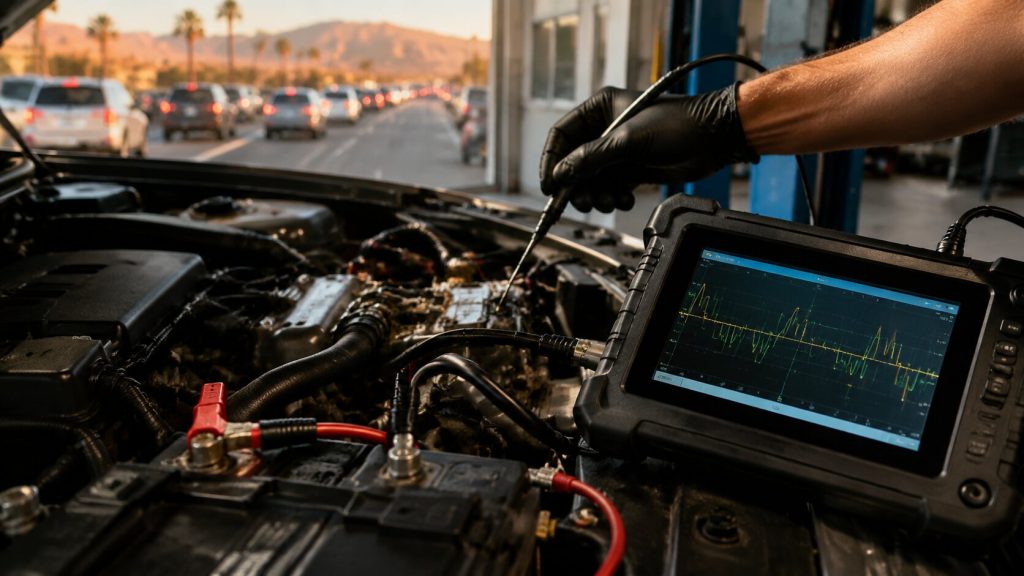
High-mileage GDI engines frequently suffer premature starter drive engagement failure when navigating heavy congestion along Broadway Blvd. The intense heat-soaking characteristic of the Sonoran Desert environment causes pinion gear teeth to grind against the ring gear due to the rapid, repeated thermal expansion cycles inherent to GDI systems.
| Field | Detail |
| Primary Symptom | Metallic grinding or a no-crank state during hot restarts |
| Target Component | Starter drive pinion and flexplate ring gear |
| Specialized Tooling | Digital storage oscilloscope with amp clamp |
| Local/Environmental Stressor | 115°F ambient heat plus idling heat soak |
| High-Risk Run | High-mileage GDI vehicles in peak Broadway traffic |
The Physics of Heat-Soaked Engagement
GDI engines utilize higher compression ratios than traditional port-injected motors, requiring the starter to exert significantly more torque to reach the required ignition RPM. When a vehicle sits in stagnant Broadway traffic, the engine block absorbs massive amounts of ambient and radiated heat. This heat-soaking effect increases electrical resistance within the starter windings.
As the internal temperature of the starter solenoid rises, the copper coils experience increased resistance, which effectively decreases the magnetic force available to throw the starter drive forward. Simultaneously, the lubricants inside the starter assembly begin to thin or break down under the thermal load.
Physical failure occurs at the junction of the pinion and the ring gear. Because the engine has not cooled down, the metal expansion of the flexplate teeth reduces the clearance between the pinion and the ring gear. The starter drive attempts to engage while tolerances are out of spec, leading to metal-on-metal impact rather than smooth meshing. Over time, the leading edges of the pinion gear become mushroomed or sheared, leading to the classic grinding noise familiar to Tucson commuters.
Precision Diagnostic Workflow for GDI Starting Systems
I rely on a specific diagnostic path to distinguish between a dying battery, a failing solenoid, or mechanical gear wear. Relying on simple multimeter voltage readings is insufficient for these high-compression GDI units.
Step 1–The Amp Draw Test
I attach a digital storage oscilloscope to the starter’s main battery lead. I look for the initial spike in current as the solenoid engages. If the spike is too low, the solenoid contacts are pitted. If the spike is too high, the motor is struggling against high internal friction or engine compression.
Step 2 – Voltage Drop Analysis
I track voltage dissipation across the relay and ground path while the starter engages. A drop exceeding 0.5 volts indicates that heat-related corrosion at the terminals is choking the power delivery.
Step 3 – Flexplate Inspection
I pull the inspection cover to manually rotate the crank. I examine the ring gear for witness marks or metal shavings that indicate the pinion is failing to seat correctly.
Parasitic Fuel Pump Loads
In GDI engines, the High-Pressure Fuel Pump adds a significant parasitic load to the valvetrain. Because these pumps are camshaft-driven and pressurize fuel to thousands of PSI, the starter must overcome the mechanical resistance of the pump plunger in addition to engine friction. During hot restarts, low oil viscosity fails to assist this process. When the starter is heat-soaked, this added load often induces failure.
I frequently see starters that crank a cold engine normally but fail at operating temperature. If the starter cannot hit the required RPM threshold, the ECU will not fire the injectors. This resulting long-crank forces the starter to remain engaged longer, compounding internal heat and rapidly destroying the bushings.
Electrical Cable and Ground Integrity
High resistance in main battery cables is frequently misdiagnosed as starter failure. Copper wiring corrodes over time, especially near GDI exhaust manifolds, where extreme heat causes insulation failure and internal strand degradation. This resistance triggers a significant voltage drop during the high-amperage demand of a cold start.
Load tests targeting the cable-to-starter connection measure voltage loss from the battery positive post to the starter solenoid during cranking. If this value is high, a new starter will not resolve the issue. Replacing compromised wiring with high-strand-count, heat-resistant cable ensures the starter receives the full voltage needed for proper engagement.
Proactive Maintenance Strategy
- Routine Terminal Cleaning: At every major service, I manually clean the battery posts and the starter solenoid connections. Removing surface oxidation significantly lowers the resistance in the circuit.
- Heat Shield Integrity: If your vehicle comes equipped with a heat shield for the starter, ensure it is still present and properly fastened. I see many vehicles come into the shop after previous repairs where the technician failed to reinstall the factory heat shielding. This omission alone can shorten the life of a starter by 40% in Tucson.
- Monitoring Crank Time: Pay attention to how long the starter engages. If the engine takes longer to start now than it did when the vehicle was new, you have a fuel delivery or compression issue that is putting excessive strain on your starter. Addressing the root cause—such as a failing fuel pump or worn timing chain tensioner—is the best way to extend the life of your starter motor.
Preventing Irreversible Flexplate Damage
Ignoring the initial signs of starter hesitation on Broadway Blvd leads to significantly more expensive repairs. When the pinion gear fails to engage smoothly, it physically chips the teeth off the engine flexplate. Replacing a starter is a routine service, but replacing a flexplate requires pulling the transmission, which represents a massive spike in labor costs and vehicle downtime.
Many drivers mistake the early warning signs of gear misalignment for a slipping drive belt, leading to deferred maintenance. By the time the vehicle refuses to start in the middle of an intersection, the damage to the ring gear is often already irreversible.
Professional Starter Assessment
Don’t let a heat-soaked starter leave you stranded in traffic. Bring your vehicle to Accurate Service Auto Repair at 843 S Campbell Ave, Tucson, AZ 85719. I will hook up the digital oscilloscope, run a real-time amp draw test on your starting system, and show you exactly where the voltage is dropping. No guessing, just diagnostic proof.
Frequently Asked Questions
Does a slow crank during the morning always mean the battery is dead?
No, oscilloscope current testing allows me to verify if sluggish cranking is due to internal starter faults, like worn brushes, or merely a failing battery.
Can I continue driving if I hear a grinding noise occasionally?
No, hearing a grinding noise indicates that the starter pinion gear is failing to mesh properly with the engine flexplate. Each instance of gear clashing accelerates material loss on the ring gear, ultimately requiring a transmission tear-down to facilitate a flexplate replacement.
Is it normal for my GDI engine to crank slower when it is 110 degrees outside?
No, while elevated temperatures naturally increase electrical resistance, a structurally sound starter still delivers sufficient rotational torque. If hot conditions routinely cause slow cranking, the starter is experiencing thermal efficiency loss and needs immediate attention.
Does changing my oil more frequently help the starter?
Yes, maintaining cooling system efficiency mitigates the ambient heat load surrounding the starter. Lower engine temperatures translate to less heat soak, which protects the starter solenoid and internal windings from premature failure.
