

Tucson’s extreme summer heat and frequent stop-start traffic around schools create a perfect storm for premature starter failure. Heat soak increases electrical resistance and causes internal solenoid pitting, leading to sudden non-start conditions. Detecting early clicking or lag prevents cascading ignition damage during school commutes.
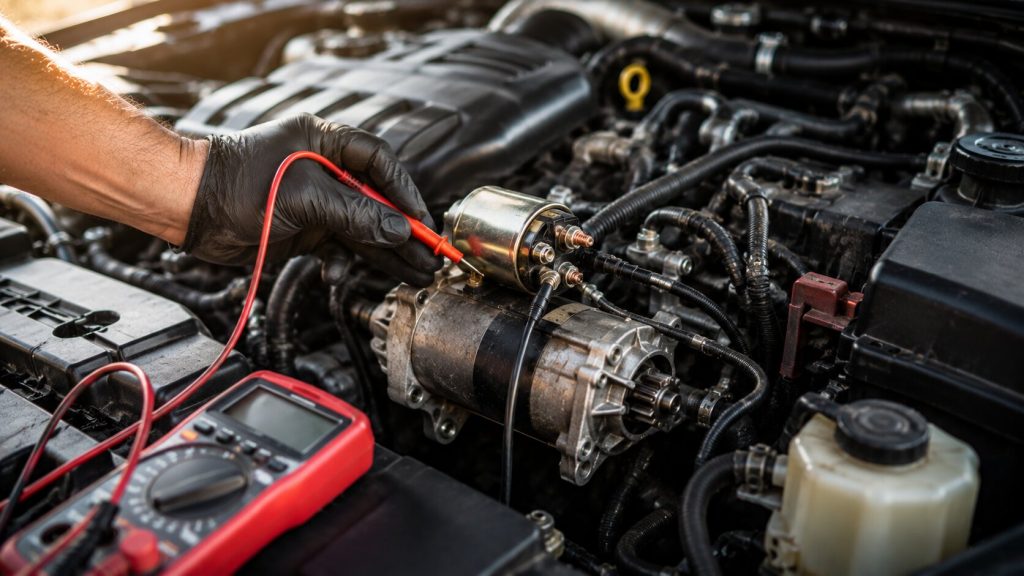
Frequent stop-start cycling during morning school drop-offs at Rincon High School prematurely consumes the internal contacts and brushes of starter motors in sedans exposed to Tucson intense summer heat soak. The combination of early morning engine cranking and subsequent high frequency engine cycling creates a compounded failure profile for starters operating in the 85719 area code.
During the July through September heat, vehicle starters face a dual threat, the electrical resistance of hot soaked engine components and the mechanical fatigue of repeated school zone stop and go patterns. Relying on an aging starter in this environment leads to sudden, no start conditions in busy pickup lanes.
Thermal Dynamics and Contact Pitting
Starter motors translate electrical input into mechanical torque via a solenoid-actuated drive. Under normal conditions, the copper windings and carbon brushes handle high amperage for brief intervals. Tucson summers force these components to operate at the edge of their thermal limits.
Heat soak causes the starter housing to expand and the internal lubricants to lose viscosity. When a parent pulls into a crowded school line, the engine reaches operating temperature. After a short idle, the engine is shut off. Attempting a restart while the starter is heat soaked increases electrical resistance. This resistance forces the solenoid to draw higher current, which leads to micro arcing at the contact points.
Repeated cycles of arcing cause the copper contacts to become pitted and galled. Eventually, the surface area becomes insufficient to conduct the required load. Engagement failure prevents cranking, often triggering a distinct clicking or complete silence. The physical degradation is not random. It is a predictable path of material erosion occurring at the molecular level where the copper bridges fail to bridge the gap due to the buildup of carbon deposits and localized melting.
Resistance Spikes in 105 Degree Environments
Electrical conductivity is inversely proportional to temperature in many metals. As the copper windings inside your starter heat up, their resistance increases. At 105 degrees, idle queues eliminate the cooling airflow critical for starter thermal regulation.
Instead, the metal retains that heat. Every time the ignition key turns, the solenoid bridge must create a perfect connection across the terminals. If those terminals are already compromised by heat induced oxidation, the current flows unevenly. This uneven flow creates localized hot spots. Over time, these spots become craters. Once the cratering reaches a depth that prevents a clean physical connection, the starter is finished. Internal resistance spikes can exceed battery current capacity, causing a solenoid stall.
Advanced Voltage Drop Testing Protocols
I approach starter diagnostics by measuring the voltage drop across the entire circuit. A standard battery test is insufficient when diagnosing intermittent heat related failures because it ignores the path of the current under load.
- Measure battery resting voltage and ensure it sits above 12.6V.
- Monitor amperage draw during a simulated hot start condition using an inductive amp clamp.
- Check for voltage drop at the starter signal terminal while the engine is at full operating temperature.
- Compare the voltage at the battery post versus the voltage at the starter stud during the crank cycle.
- An acceptable voltage drop on the main power cable is less than 0.2 volts. Anything exceeding 0.5 volts indicates a connection failure or cable degradation.
Micro Climate Stressors at Campbell Ave
Driving patterns around 843 S Campbell Ave expose vehicles to specific micro climatic stressors. The asphalt around local schools retains extreme heat even during early morning hours. This ambient heat prevents the starter from shedding the energy absorbed during the previous ignition cycle.
Vehicles idling in drop off queues experience restricted airflow. The starter motor sits near the exhaust manifold on many front wheel drive sedans. This proximity creates a thermal trap. Over several weeks of school drop offs, the insulation on the starter solenoid wiring can become brittle. Brittle insulation leads to intermittent shorts, further masking the root cause as a battery or alternator issue. This is why I prioritize cleaning and heat wrapping connections for vehicles that frequent these specific high density routes.
Pinion Engagement and Metal Contamination
I often see vehicles where the starter gear teeth show signs of premature wear. This happens when the solenoid does not snap the pinion gear into the flywheel with enough force. Wiring harness degradation frequently restricts solenoid voltage, hindering proper engagement.
When the gear does not fully seat, it grinds against the ring gear. This creates metal shavings that can fall into the starter housing, causing internal shorts. If you hear a grinding noise during your morning routine, you are likely looking at a failing drive assembly that will soon strand you in the middle of a busy traffic lane. Metal debris forms conductive bridges, inducing internal arcing that accelerates component failure.
Secondary Failure Chains in Ignition Circuits
Many drivers ignore the first few times their car hesitates to start. They attribute it to a fluke or a bad battery. However, in the Tucson climate, there is rarely such a thing as a fluke in the starting circuit. A starter that is struggling is a starter that is drawing too much current.
This extra draw places a massive amount of stress on the battery cables and the ignition switch. I have seen many instances where a cheap starter replacement turned into a full electrical harness repair because the owner ignored the clicking sound for too long. By the time the solenoid fails, the electrical load may have already compromised the ignition switch contacts, meaning you now have two failed components instead of one.
Heat Shielding and Terminal Conductivity
Start by cleaning and torquing all electrical connections. Corrosion on the main starter stud is inevitable here thanks to our extreme desert heat cycles.
If your exhaust runs near the starter, install a reflective heat shield. This can lower the solenoid temperature by 20 to 30 degrees, effectively doubling the lifespan of the internal contacts. Finish by applying dielectric grease to the terminals; it’s the only way to seal out moisture and stop desert-dust-induced oxidation.
Preventing Cascade Failures and Engine Damage
Waiting until a complete failure occurs in a school parking lot often leads to secondary damage. A starter that is internally shorting can draw excessive current that puts a massive load on the battery and the ignition switch. Frequent failed start attempts also dump unburnt fuel into the cylinders, which can eventually wash oil from the cylinder walls and contaminate the engine oil.
Schedule your starter system inspection at Accurate Service Auto Repair, 843 S Campbell Ave, Tucson, AZ 85719 to ensure your vehicle handles the morning commute without incident.
Frequently Asked Questions
Does the age of my battery affect starter wear during heat waves?
Yes, a weak or aging battery causes the starter solenoid to chatter instead of engaging fully. This rapid on off cycling creates electrical arcs that destroy the starter contacts much faster than a single, clean engagement, especially when the starter is already struggling against thermal resistance.
Does my car struggle to start only after driving a short distance?
Yes. This is a classic sign of heat-soak. Post-drive, engine heat increases the internal electrical resistance (impedance) of the starter motor, making it difficult for aged cables or worn internal components to deliver the necessary current to engage the solenoid.
Is the starter noise different from a battery issue?
Yes, a battery issue typically sounds like rapid clicking or a slow crank. A failing starter often produces a single, loud click or a high pitched whine without any engine turning over.
Can I prevent starter wear during school drop off traffic?
Yes, reducing engine-off cycles in queues directly mitigates cumulative starter heat soak. Keeping the engine running or only turning it off for extended wait times significantly reduces the total number of heat soak cycles the starter experiences during your commute.
