

When your engine overheats while idling but cools down on the highway, a faulty cooling fan, not a damaged radiator, is usually to blame. While radiators rely on vehicle motion for airflow, cooling fans actively pull air at low speeds. Diagnosing relay failures, blown fuses, and PWM control modules first prevents misdiagnosis and avoids expensive, unnecessary radiator replacements.
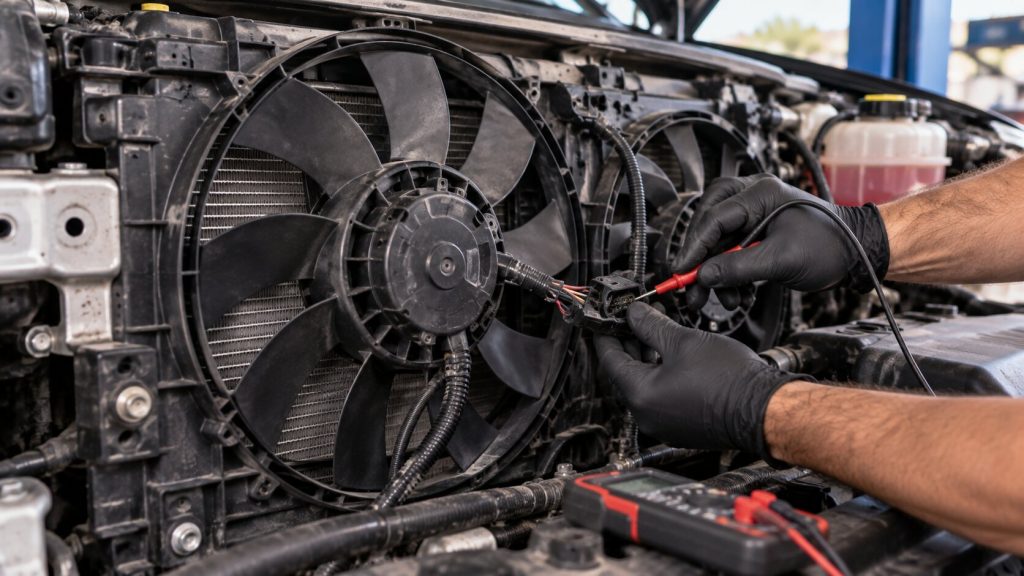
Every summer in Tucson, drivers walk into my shop believing their radiator has completely given up. They pull up with the temperature needle pinned near the red line, convinced they are facing a full cooling system replacement. But after popping the hood and hooking up diagnostic gear, I consistently find that the radiator core is completely intact. The real issue is almost always a failure in the electrical control chain that keeps the cooling fan from pulling air at a dead stop. Understanding how these systems fail at low speeds is the key to preventing severe engine damage without replacing parts that still work perfectly.
The Tucson Thermal Trap at 105°F on Campbell Avenue
When I sit at a red light on Campbell Avenue in 105°F heat, I see cooling systems pushed to their absolute limits. When ambient temperatures cross 100°F, A/C high-side pressures quickly climb past 320 PSI. The A/C condenser mounted directly in front of the radiator radiates intense heat. Without an operational electric fan pulling air through that cooling stack, I watch coolant temperatures climb past 230°F within 60 seconds of coming to a complete stop.
Why Speed Changes Everything
A client arrived after spending a fortune at another shop for a replacement radiator on a 2018 Ford Explorer. The engine was still overheating, but only at low speeds. When I hooked up my scan tool, I saw the ECM commanding a 92% fan duty cycle for high-speed operation. I had 13.8 volts at the harness, but my meter showed 0.0 amps of current draw. The culprit was simply a burnt ground pin inside the 4-pin harness connector, which I repaired with a standard OEM pigtail.
The underlying mechanics break down into two distinct driving conditions. At 55 mph down I-10, ram air pressure forces enough ambient air through the grille to cool the radiator core without any fan assistance. At a dead stop, that natural airflow drops to zero, making the electric cooling fan the sole mechanism pulling air across the cooling fins.
If your engine temperature drops as soon as you accelerate onto the highway, your radiator is likely fine and cooling fan problems are typically the true root cause in your airflow generation or electrical control chain.
The Electrical Failure Chain Where Modern Systems Break Down
Modern electric fans are controlled by ECM duty cycles and pulse-width modulation modules rather than simple mechanical belts.
| Component | Common Failure Mode | Shop Measurement or Symptom |
| PWM Fan Module | Solid-state transistor short from heat soak | Constant 0% or 100% fan engagement regardless of temp |
| Relay Contacts | Pitting and melting under sustained load | High resistance drop greater than 0.5V across closed terminals |
| Coolant Temp Sensor | Signal drift or internal resistance shift | Reads 180°F to ECM when actual engine temp is 230°F |
| Fan Motor Harness | Thermal degradation and loose terminal tension | Charred plastic housing or intermittent open circuit |
The High Cost of Misdiagnosis
Driving with a non-functional cooling fan quickly escalates into structural engine damage that I frequently have to rebuild in my shop.
- Warped Cylinder Heads: Aluminum cylinder heads expand rapidly when coolant temperatures cross 240°F, unevenly distorting the deck face and causing a total loss of compression.
- Blown Head Gaskets: Thermal expansion differentials between an iron block and an aluminum head crush the fire rings on the head gasket, causing catastrophic leaks.
- Ruptured Cooling Lines: System pressure exceeding the 16 PSI radiator cap threshold splits plastic end-tanks and causes sudden radiator hose blowouts.
How I Test the Cooling Fan Circuit
To isolate the failure point before condemning major components, I follow a systematic diagnostic procedure.
- Command Low and High Speed via Bi-Directional Scan Tool: I send a manual command from my scanner to trigger a 100% duty cycle. If the ECM commands the fan on but nothing happens, I move directly to pin testing at the fan harness..
- Perform Voltage Drop and Amp Draw Tests: Probing the back of the fan connector with my multimeter confirms full battery voltage under load. I use an inductive amp clamp to check whether the motor draws its nominal 18 to 25 amps or stays at 0 amps.
- Inspect Terminal Tension and Harness Integrity: My visual inspection often reveals melted plastic or loose female terminals at the shroud connector. Restoring drag tension on the pins frequently restores fan operation without needing a new motor assembly.
Get Pinpoint Cooling Diagnostics in Tucson
Don’t replace your radiator before verifying whether an electrical fan failure is the real culprit. At Accurate Service Auto Repair, I perform complete circuit, PWM signal, and component testing to pinpoint your exact cooling issue without throwing away money on unnecessary parts. Visit us at 843 S Campbell Ave, Tucson, AZ 85719 to get an honest, accurate diagnosis.
Frequently Asked Questions
Can a bad cooling fan cause my car to overheat only when idle?
Yes. A failing cooling fan almost exclusively causes overheating at an idle or low-speed stop-and-go driving. At highway speeds, passive ram air airflow cools the radiator, making fan operation unnecessary until vehicle speed drops below 30 mph.
How do I know if my cooling fan relay is bad?
A bad fan relay typically fails in two ways: stuck open, which prevents power delivery so the fan never runs, or welded shut, which causes the fan to run continuously until the battery drains. I test relays by checking resistance across pins 85 and 86, and measuring voltage drop across pins 30 and 87 when energized.
Is it safe to drive my car if the cooling fan isn’t working?
No. Driving without an operational cooling fan risks severe engine damage from rapid heat soak whenever you stop moving. If you must drive short distances to safety, turn on your heater to maximum heat and fan speed to help pull thermal energy out of the engine block.
Will replacing the radiator fix cooling fan problems?
No. Replacing the radiator will not fix an airflow or electrical issue caused by a dead fan motor, melted harness connector, blown fuse, or faulty PWM control module. The underlying control problem will remain unresolved.
